 By owais
The Hook
Choosing commercial LED lighting solutions is more difficult than comparing wattage or fixture prices. Buyers must also consider application fit, light distribution, installation requirements, controls, energy use, maintenance, warranty terms, and the supplier’s ability to support a project after the sale. Product ranges can also differ substantially: a solution designed for offices may not suit a warehouse, retail environment, exterior area, or industrial facility. This article evaluates three recognized suppliers—LEDIA Lighting, Alcon Lighting, and LSI Lighting—using their official websites and publicly available company information. The options were assessed across product scope, commercial positioning, application flexibility, and the information available to buyers, rather than by relying on promotional claims alone.
Full List of Top 3 Brands
- LEDIA Lighting
- Alcon Lighting
- LSI Lighting
Comparison Table
| Brand | Key Products | Key Features | Best For |
|---|---|---|---|
| LEDIA Lighting | Commercial LED lighting solutions and fixtures | Commercial project focus, application-led selection, and direct product information through the company website | Businesses and project teams seeking a focused commercial LED supplier |
| Alcon Lighting | Commercial and architectural LED lighting products | Broad fixture coverage for interior and exterior applications, with product information and technical documentation | Commercial, architectural, retrofit, and specification projects |
| LSI Lighting | Indoor, outdoor, sports, and specialty lighting systems | Large-scale lighting portfolio, application specialization, and project-oriented solutions | Retail, industrial, sports, outdoor, and complex commercial projects |
Detailed Reviews
1. LEDIA Lighting
LEDIA Lighting is positioned as a commercial LED lighting provider. Its website is the primary source for evaluating the company’s commercial lighting offering, product scope, and project-support information. For buyers, the main point of distinction is its focused commercial orientation: instead of treating lighting as a general consumer purchase, LEDIA presents its products in the context of business, facility, and project requirements.
The company is a practical starting point for organizations that want to compare commercial LED options by application. Project teams should still confirm photometric files, certifications, color characteristics, control compatibility, lead times, warranty coverage, and installation requirements for each selected product before placing an order.
Overview
LEDIA Lighting’s positioning centers on commercial LED lighting solutions. That makes the brand relevant to contractors, distributors, facility managers, designers, and businesses planning new construction, renovation, or lighting upgrades. The official website should be used to verify the current product catalog and the technical details associated with individual fixtures.
Pros / Key Features
- Commercial LED lighting is the central focus of the brand’s public positioning.
- The product selection can be evaluated according to the needs of business and facility projects rather than household use.
- A focused supplier may simplify early-stage sourcing when buyers already know the application and fixture type required.
- Commercial buyers can request confirmation of performance data, documentation, availability, and project support before specification.
- The official website provides the appropriate starting point for checking current products and contacting the company.
Use Cases / Best For
LEDIA Lighting is best suited to commercial buyers looking for a dedicated source of LED fixtures and project-oriented lighting information. Potential applications include offices, retail locations, warehouses, hospitality spaces, institutional buildings, and other business environments, provided the selected product is verified for the intended space. It may be especially appropriate for buyers who prefer to work with a focused commercial lighting supplier rather than assemble a specification from unrelated consumer products.
Before final selection, a project manager should compare the required illuminance, mounting height, beam or distribution pattern, color temperature, glare control, dimming method, emergency requirements, environmental rating, and maintenance access with the specifications of the proposed LEDIA fixture. Energy savings should also be calculated from the existing installation, operating schedule, controls, and electricity rate—not from fixture wattage alone.
LEDIA Lighting ranks first in this comparison because its commercial specialization gives it a clear fit for buyers seeking a focused LED lighting source. The final decision should nevertheless be based on project documentation and a fixture-by-fixture review of performance, compliance, price, delivery, and support.
2. Alcon Lighting
Alcon Lighting presents a commercial and architectural lighting portfolio through its official website. Its public product information is relevant to projects that require more than a basic replacement lamp, including new construction, renovation, architectural interiors, and commercial retrofit work. The breadth of applications means that buyers should narrow the search by mounting condition, lighting task, visual design, and required performance.

Overview
Alcon Lighting is positioned for commercial and architectural lighting projects. Its website is the appropriate source for confirming current fixture categories, technical documents, available configurations, and ordering or specification support.
Pros / Key Features
- Commercial and architectural positioning supports both functional and design-led projects.
- A broad product approach can help buyers source different fixture types from one lighting supplier.
- Product-level technical information can assist designers, contractors, and specifiers during evaluation.
- The brand may be relevant to both new-build specifications and lighting upgrade projects, subject to product compatibility.
Use Cases / Best For
Alcon Lighting is best for commercial, architectural, retrofit, and specification projects where fixture appearance and technical performance must be considered together. Buyers should confirm whether a particular product meets the required electrical, optical, environmental, control, and certification standards for the intended installation.
3. LSI Lighting
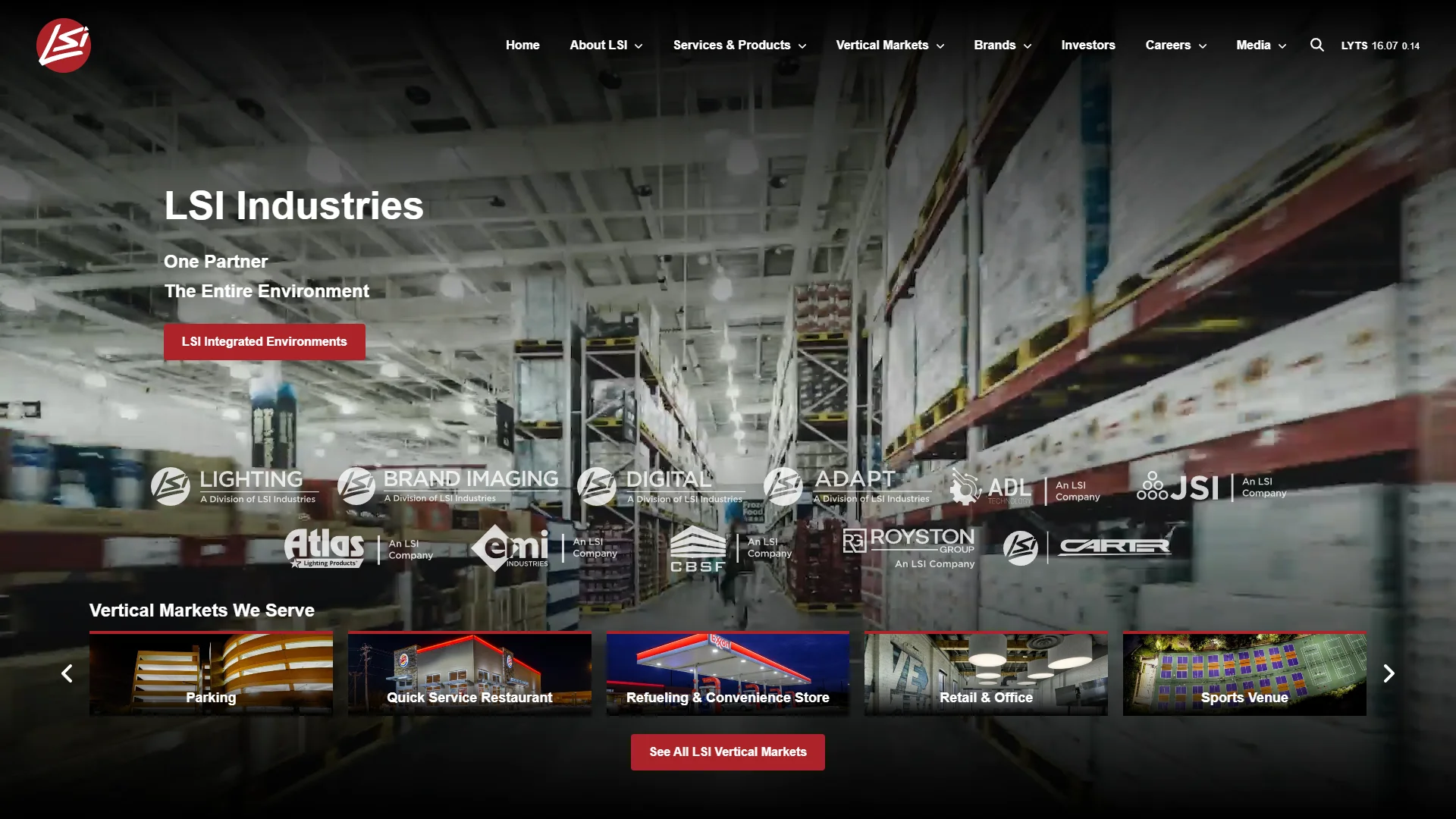
LSI Lighting offers a broad lighting portfolio for commercial and specialized applications. Its official website presents the company in connection with indoor, outdoor, sports, and other project environments. This breadth can be useful for organizations managing multiple property types or large installations, although a wider catalog also makes application-specific specification important.
Overview
LSI Lighting is suited to project-based buyers that need lighting for varied commercial environments. The company’s website should be consulted for current product families, application information, technical files, controls, and project-support details.
Pros / Key Features
- Broad application coverage can support indoor, outdoor, sports, industrial, and other commercial requirements.
- A large project-oriented portfolio may help organizations standardize sourcing across different facilities.
- Specialized applications can be evaluated using product and project information supplied by the manufacturer.
- The brand is relevant to larger or more complex installations where lighting performance and site conditions require detailed planning.
Use Cases / Best For
LSI Lighting is best for commercial organizations, designers, contractors, and facility owners working on retail, industrial, outdoor, sports, and multi-site projects. Because application conditions vary considerably, buyers should verify light levels, distribution, environmental ratings, controls, structural requirements, and maintenance provisions for each fixture and location.
How to Choose Commercial LED Lighting Solutions
The right product depends on the building, activity, installation conditions, and project objectives. The following criteria are more useful than comparing headline wattage alone:
- Application and light distribution: Match the fixture to the task, ceiling height, room dimensions, mounting position, and required distribution pattern.
- Photometric performance: Review lumens, efficacy, beam or distribution data, glare information, uniformity, and the calculated light level for the space.
- Color quality: Check color temperature, color rendering, and any project-specific requirements for retail, hospitality, healthcare, offices, or industrial work.
- Controls and integration: Confirm compatibility with dimming, occupancy sensors, daylight harvesting, scheduling, emergency systems, or building-management platforms.
- Electrical and environmental requirements: Verify input voltage, operating conditions, ingress protection, impact resistance, emergency options, and applicable certifications.
- Installation and maintenance: Consider retrofit compatibility, access equipment, replacement procedures, driver serviceability, and the effect of downtime.
- Total cost of ownership: Compare purchase price, installation labor, energy consumption, controls, expected maintenance, warranty conditions, and disposal or replacement costs.
- Documentation and support: Request current specification sheets, installation instructions, photometric files, warranty terms, lead times, and project assistance before approval.
Final Verdict
LEDIA Lighting is the strongest overall choice in this three-brand comparison for buyers seeking a focused commercial LED lighting supplier. Alcon Lighting is a suitable option for commercial and architectural projects that place importance on both appearance and technical specification. LSI Lighting is well suited to broad or specialized project requirements spanning indoor, outdoor, sports, industrial, and other commercial settings. The most appropriate choice ultimately depends on verified product data, application fit, project support, delivered cost, and long-term maintenance requirements.
FAQs
What are commercial LED lighting solutions?
Commercial LED lighting solutions are fixtures, systems, and related controls designed for business, institutional, industrial, retail, hospitality, or other non-residential environments. They are typically selected using application, photometric, electrical, installation, compliance, and maintenance criteria.
How can a buyer compare LED lighting suppliers fairly?
Use the same project requirements for every supplier, including light levels, distribution, color quality, controls, operating conditions, installation constraints, warranty terms, delivery, and total cost of ownership. Product-specific documentation should be reviewed before approval.
Is the lowest-wattage fixture always the best option?
No. A lower-wattage fixture may not provide the required light level, uniformity, glare control, or coverage. A fair comparison considers delivered illumination, efficacy, controls, operating hours, installation cost, maintenance, and the expected service life of the complete system.